One keystroke breaks a formula
A deleted row, a dragged cell, and a total is quietly wrong. Nobody notices until the client does, or until the margin on that room has already gone.

Your format is good. It still cannot change a finish tier while the client is watching.
Interix is an Excel alternative for interior design quotations and BOQs, built for the client meeting. It is not for everyone.
Stay in Excel if you quote a handful of one-off jobs a year and nothing repeats between them.
Leave Excel if clients ask what a better finish would cost, if revisions arrive in threes, or if you have ever said "let me get back to you on that". Those are the three things a sheet cannot answer in the room.
Almost every studio works the same way, and it is the sensible way to work in a spreadsheet.
It is quick, and it produces a starting figure. What it cannot produce is a second option, a revision that explains itself, or a rate your whole studio agrees on.
A spreadsheet is a brilliant calculator. A quotation is a document, a negotiation and a record, and it is none of those.
A deleted row, a dragged cell, and a total is quietly wrong. Nobody notices until the client does, or until the margin on that room has already gone.
V1, V3_Final, V4_Really_Final. The client approves one item from the third file and another from the fifth, and assembling the real quotation is guesswork.
Ply, hardware, laminate, all moving. The new rate has to be found and retyped in every live sheet, and the ones you miss keep quoting last year's cost.
You are selling craft and taste. A gridlined spreadsheet, or the PDF it prints, says the opposite before a single number has been read.
Page breaks in the wrong place, a column spilling onto sheet two, scaling that shrinks the text. You lay it out again every time you send one.
Standing in a showroom, asked what a change does to the budget. Four hundred rows on a phone is not an answer, so the answer becomes tonight.
The logic sits in your head and in one file. Anyone else who quotes produces something you have to check line by line before it can go out.
A client wants the wardrobe you did in a similar flat. Finding what you charged means opening old files one by one until you recognise it.
Two days is not a delay. It is a window, and they spend it in somebody else's inbox.
A price in the meeting feels like confidence. The same price on Thursday feels like a delay.
They will not remember your rate. They will remember that you answered.
Most of it can. The middle column is the part nobody prices.
| You want to | In Excel | What that costs | In Interix |
|---|---|---|---|
| Offer a better finish | Build a second sheet | Tonight, after they have left | Switch the tier, watch it re-price |
| Mix one premium item in | Hand-edit that single rate | The sheet now contradicts itself | The item carries its own tier |
| Drop something they refuse | Promise a revised quotation | A second meeting, a smaller number | Untick it, new total, in the room |
| Split a counter into parts | Merged cells, or a new sheet | They see one figure and ask why | Sub-items priced under one line |
| Save this version | Save-as, with a new suffix | Quote_V4_Really_Final.xlsx | R4, saved as its own snapshot |
| Go back two versions | Open four files and compare | Nobody knows which one was approved | Restore the one they approved |
| Take a vendor price rise | Retype it in every live sheet | Older projects keep the old price | Edit the card, new projects follow |
| Show them the screen | Turn the laptop around | They read your rates and your margin | One switch hides rates and sizes |
| Give a discount | Type a smaller number | No credit for it, and they push again | Flagged on the line, totalled as saved |
| Check a figure on site | Open 400 rows on a phone | You promise to confirm this evening | Laid out for a phone, works offline |
| Let them change it | Send a PDF and wait | They decide with you out of the room | They tick, untick, and own it |
Nothing in the right column is a faster way to type. Each one is something a spreadsheet does not do at any speed.
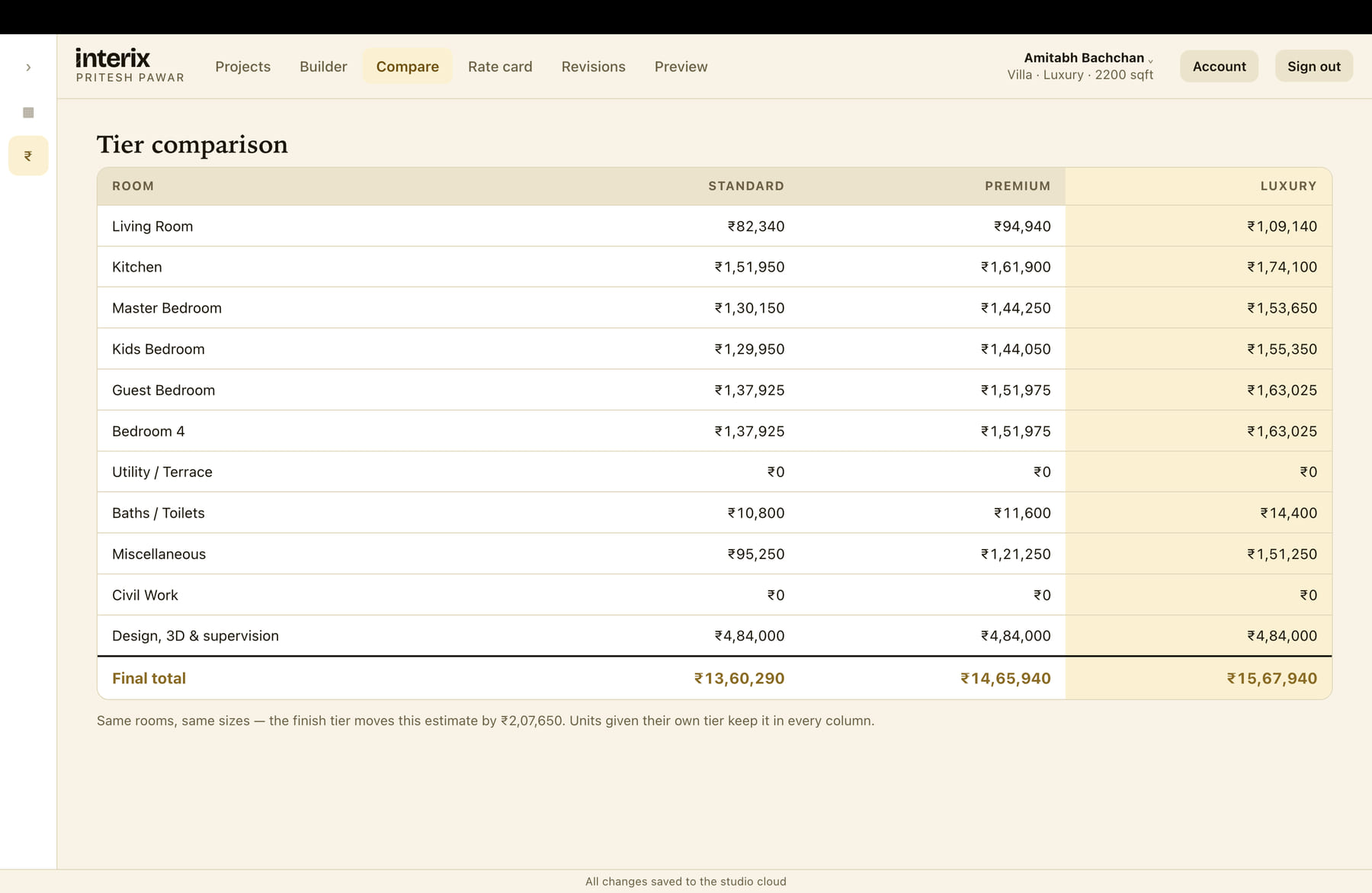
You quote standard, premium and luxury. Never side by side, because a sheet holds one column of numbers at a time.
So the better finish becomes a second file, built tonight, and the client compares the two on their own, days later, without you in the room to explain the difference.
Every finish, every room, one screen, and the gap between them in rupees.
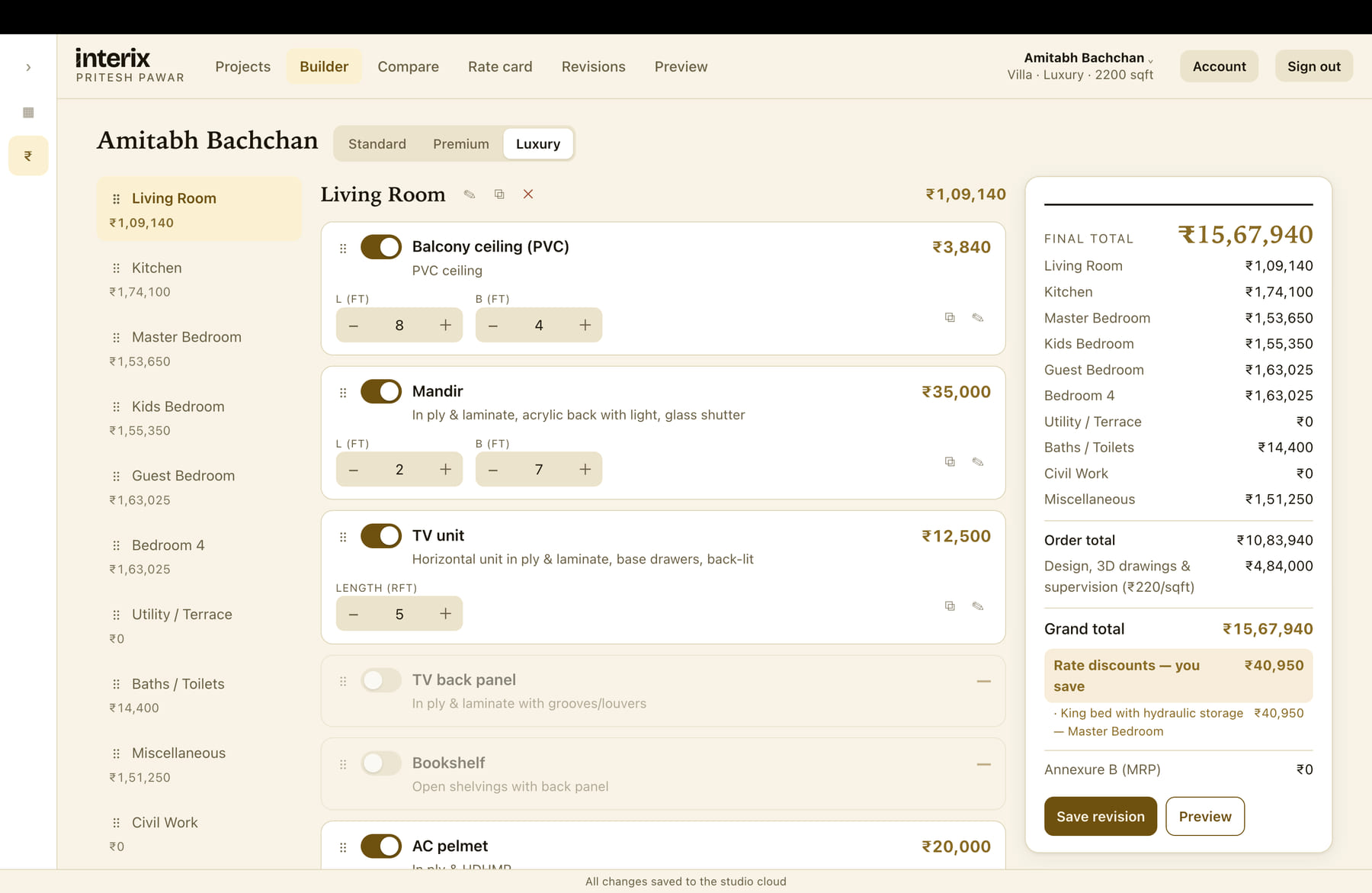
A client who chose every line does not treat the total as your opinion. They treat it as theirs.
And the total moves before they finish the sentence. No promise to revise, no second meeting to show a smaller number.
One item, one tier, priced against the rest of the job. The upgrade is theirs, so it does not get negotiated back down.
Flagged on the line and totalled. In Excel a discount is a smaller number nobody credits you for, so they keep pushing.
Not one you sent them. One they built. That is a different conversation when the comparison quotes arrive.
Three numbers you already know. Nothing is sent anywhere.
Your arithmetic, not ours. We have assumed no change at all to your win rate. This is only the value of work already passing through your hands, set against the time it spends undecided.
Excel is not going off your machine, and it should not.
A single fabrication job, priced from scratch, that resembles nothing you have quoted before. A blank sheet is faster than any structure.
Site measurements, vendor comparisons, a running cost sheet for your own eyes. Interix prices the client document and nothing else.
Excel is already paid for. Interix is a subscription, and that is a real difference. Every estimate exports back to Excel, so leaving costs you nothing.
You are not. Two of these three are mine.
Any format. The more there are, the more of your card comes back right the first time.
Your item names, your wording, your rates, your finishes. Included, at no cost.
Then your next meeting is the first one you quote in. That is the whole switch.
What it is not: magic. A rate you have never quoted still gets typed the first time you need it, and it stays on the card afterwards. And every quotation exports back to Excel, so if you leave, you leave with your numbers in the format you arrived in.

The one that keeps your existing format and adds what a sheet cannot do: a rate per finish tier so the whole estimate re-prices at once, revisions that state their own change and restore in a click, and a switch that hides your rates while the client is looking at the screen. Interix is built around those three, and it exports back to Excel so nothing is trapped.
For typing a quotation, a well-built spreadsheet is fine and most studios have one. The difference is everything after: pricing a second option without rebuilding the sheet, giving one item a different finish from the rest, knowing what changed between two revisions, and showing the document to a client without exposing your margin. A spreadsheet does none of those, however well it is built.
Yes. Every project is a room-wise bill of quantities: items with their measure, size, quantity and rate, sub-items priced underneath where a line breaks into parts, and category and room totals that roll up to the final figure. It prints as a branded document and exports as Excel.
Keep the format. Setup rebuilds your existing quotation inside Interix with your item names, your wording, your order and your rates, so what the client receives looks like what you send today. What changes is that it becomes editable in front of them, revisions stop being duplicated files, and a rate change reaches every future project instead of the one sheet you remembered to fix.
Yes, and that is how onboarding works. You send past quotations in whatever format they are in, your rate card is built from them, and you spend about twenty minutes checking it. Nothing is invented: anything ambiguous is asked about rather than guessed.
Yes. Every item holds a rate per finish tier, so switching the tier re-prices the whole estimate at once, and any single item can sit on a different tier from the rest of the job. The Compare tab puts the tiers side by side with the difference in rupees.
Only if you want them to. Rates and sizes are hidden by default and come back on one switch, so the client reads item names and line totals. In a spreadsheet the equivalent is hidden columns, which anyone who has used Excel can unhide.
Yes. Every quotation exports as Excel and as a branded PDF under your own letterhead. Clients who want a sheet still get a sheet, and if you ever stop using Interix your quotations leave with you in the format you arrived in.
The card has to exist, and we build it for you from quotations you have already sent, at no cost. It is not exhaustive on day one: a rate you have never quoted still gets typed the first time you need it, and it stays on the card afterwards.
Yes. Plenty of studios gather requirements first and quote afterwards. You get the document, the rate card and the revision history either way. The live part is there the day you want it, on the client who asks what a better finish would cost.
I will tell you straight whether this is worth switching for, and which parts of your sheet it does not replace.