“What would it be in a cheaper finish?”
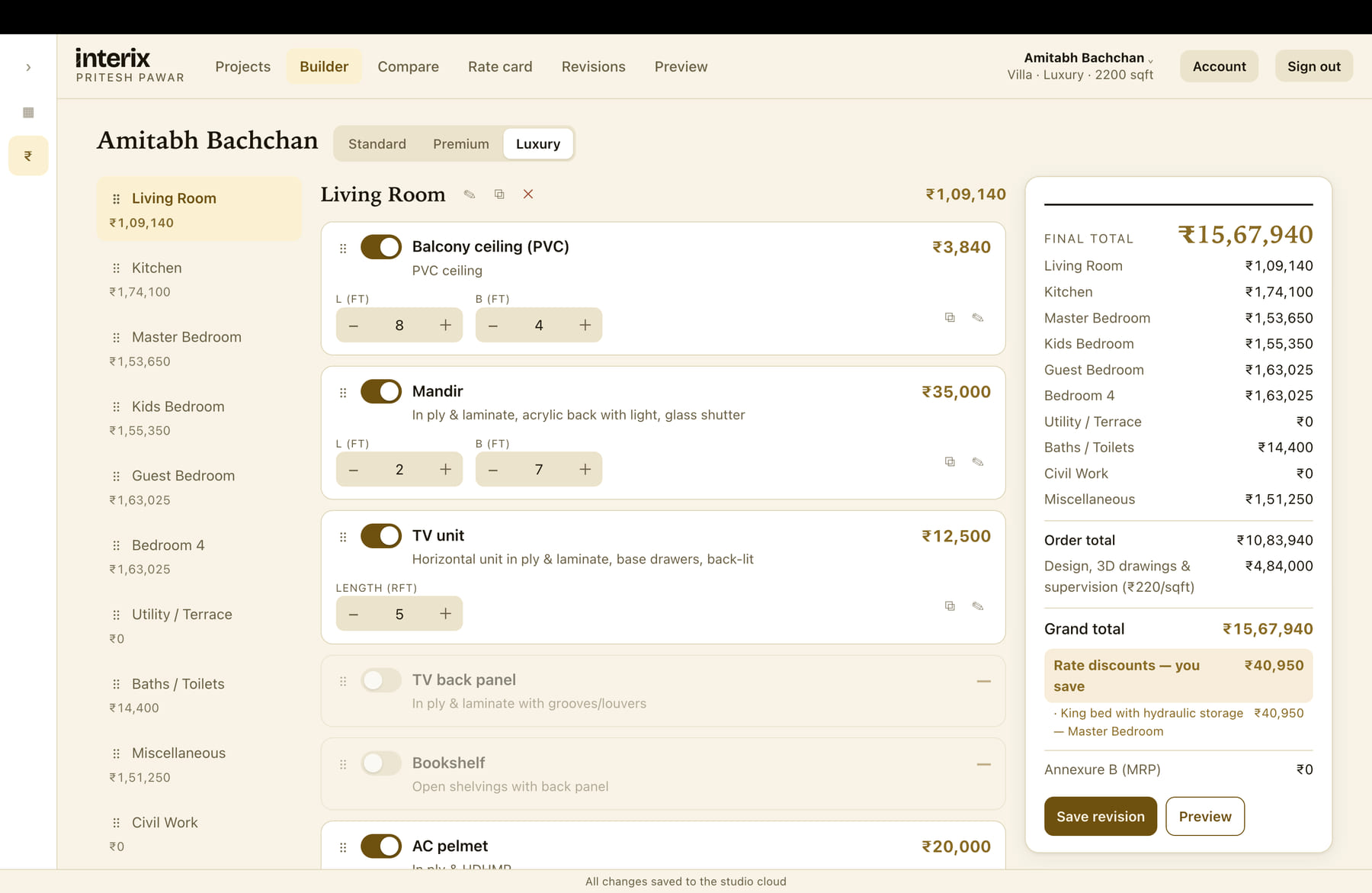
Today that is the whole quotation typed again. Here every piece sits on its own finish tier, so you switch it and the total re-prices in front of them.

Wardrobes, beds, storage and loose pieces, priced live on your own rates. They get the number while they are still sitting with you.
One walk-in enquiry, priced the way most of this market still prices it.
They walk in with a room in mind and a number already in their head.
You measure. Then you open the last customer's sheet and start deleting.
Two other quotations reach them before yours does.
The wait“Can we see it in a cheaper finish?” Another sheet. Another evening.
Every enquiry costs you an evening of typing, and every evening you take is another day they spend comparing you to someone cheaper.
The moments that decide a furniture order, and where each one currently goes wrong.
Today that is the whole quotation typed again. Here every piece sits on its own finish tier, so you switch it and the total re-prices in front of them.
One rate column cannot hold two finishes in the same order. Each piece carries its own tier and the total still adds up.
In Excel the answer is somewhere in Final_v3_updated_233.xlsx. Every revision here states its own change: down ₹42,000, three pieces removed, restorable in a click.
Your sheet has cost and margin in the next column. Rates and sizes are hidden by default and come back with one switch.
That sentence is the order leaving the room. The quotation is finished, priced and printed under your letterhead before they stand up.
You quote there. It runs in a browser on a phone, works fully offline, and syncs the moment you are back on signal.
Toggle the pieces, switch the finish tier, watch the total move. This is the product's own pricing logic, running on a sample catalogue.
Piece names and line totals only. Your rates, sizes and what you make on the order stay behind a menu.
Basic carcass, premium finish, luxury hardware, in one quotation. Switch one without touching the rest.
Each version states what changed and by how much. Restore an earlier one when they change their mind.
Change a rate and every new quotation follows it. Your boards, your hardware, your polish, in one place.
Type a piece name and your own units come up, from every room, with their measure and their rate attached.
Load it once and quote the whole site offline. Everything you enter syncs as soon as you have a connection.
In a sheet a discount is just a smaller number. Here it is flagged on the line and totalled as savings.
Print the customer document under your own letterhead. Some buyers still want a sheet, so Excel exports too.
Nothing about how you quote an order has to change to fit the software.
I build your rate card from your past quotations, at no cost, and you quote real customers on it for a month.
Yes. It prices from whatever rate card you give it, per square foot, per running foot or per unit, so a furniture catalogue behaves the same way an interior BOQ does. Interix was built inside a design studio in Pune, which is why the sample catalogue on this page is a whole flat.
No. Setup rebuilds your existing quotation inside the tool. Your wording, your rates, your structure, your terms. It stays your quotation.
Yes. A unit can carry sub-items, so a wardrobe with its loft and its fittings sits as one line with its parts listed under it, priced separately.
No. Every item carries its own measure. Square foot for carcass work, running foot for anything priced by length, and per unit for fittings and loose furniture.
Only if you choose to show them. Rates and sizes are hidden by default, so you can turn the screen around mid-meeting.
Load it once and everything keeps working. Edits queue locally and sync when you are back online. You do not lose work.
You send past quotations, I build the rate card, you check it in about twenty minutes. That is the whole onboarding.
Yes. GST is applied to the estimate and appears on the customer document, in rupees, alongside the total.
Your business gets one login today, shared across your devices, and it stays signed in. Per-user accounts are next.
You keep quoting, or you walk away and I stop. No lock-in, and your rate card is yours to export either way.
If Interix is not right for your business I will say so, and you will have lost four minutes.
Or try it on this page first. Nothing to sign up for.